
Imply Lumi product update: what’s new


Since releasing Imply Lumi in September 2025 as a decoupled data layer for observability, the Imply R&D team has been hard at work to make it easier and more economical to retain, query, and analyze observability data — without disrupting existing workflows
This blog highlights recently delivered capabilities across ingestion, performance, and Splunk interoperability.
Ingest, retain, and access more observability data
Lumi is designed to store and query observability data at a fraction of the cost of traditional platforms, without forcing teams to choose between retention and performance.
We’ve made a number of significant performance improvements to help you make your datasets queryable as quickly as possible. By optimizing historical data loading with date-based partitioning and a dedicated processing queue, you can now efficiently load and query your historical datasets while keeping real-time events a priority. To help you easily identify and resolve data collection issues, we’ve added a view to identify unparsable events that weren’t able to be collected.
Our event collection systems have optimized autoscaling and reduced memory and CPU utilization, resulting in higher ingestion scalability, reduced storage size, and lower query latency.
Predefined pipelines enable you to process common data types. Pipelines apply standard parsing and enrichment rules so your data is ready to use as soon as it’s ingested. We’re continuously expanding our out-of-the-box dataset coverage and support for VPC flow logs and Windows event logs is now available.
Operate with your existing workflows
Imply Lumi is built to extend Splunk, not replace it.
You can leverage a wide range of SPL commands to query Lumi events from Splunk, including the core commands Splunk users rely on daily. Use stats to aggregate data, timechart and chart to visualize trends, and eval to create calculated fields. Filter results with search and where, extract patterns with rex, parse JSON with spath, and identify common values with top and rare. These commands give you the analytical power to explore Lumi event data directly from your familiar Splunk interface.
You can easily update Splunk dashboards to point at Lumi events. This Splunk dashboard shows site activity from Apache web logs, querying using Lumi federated search:
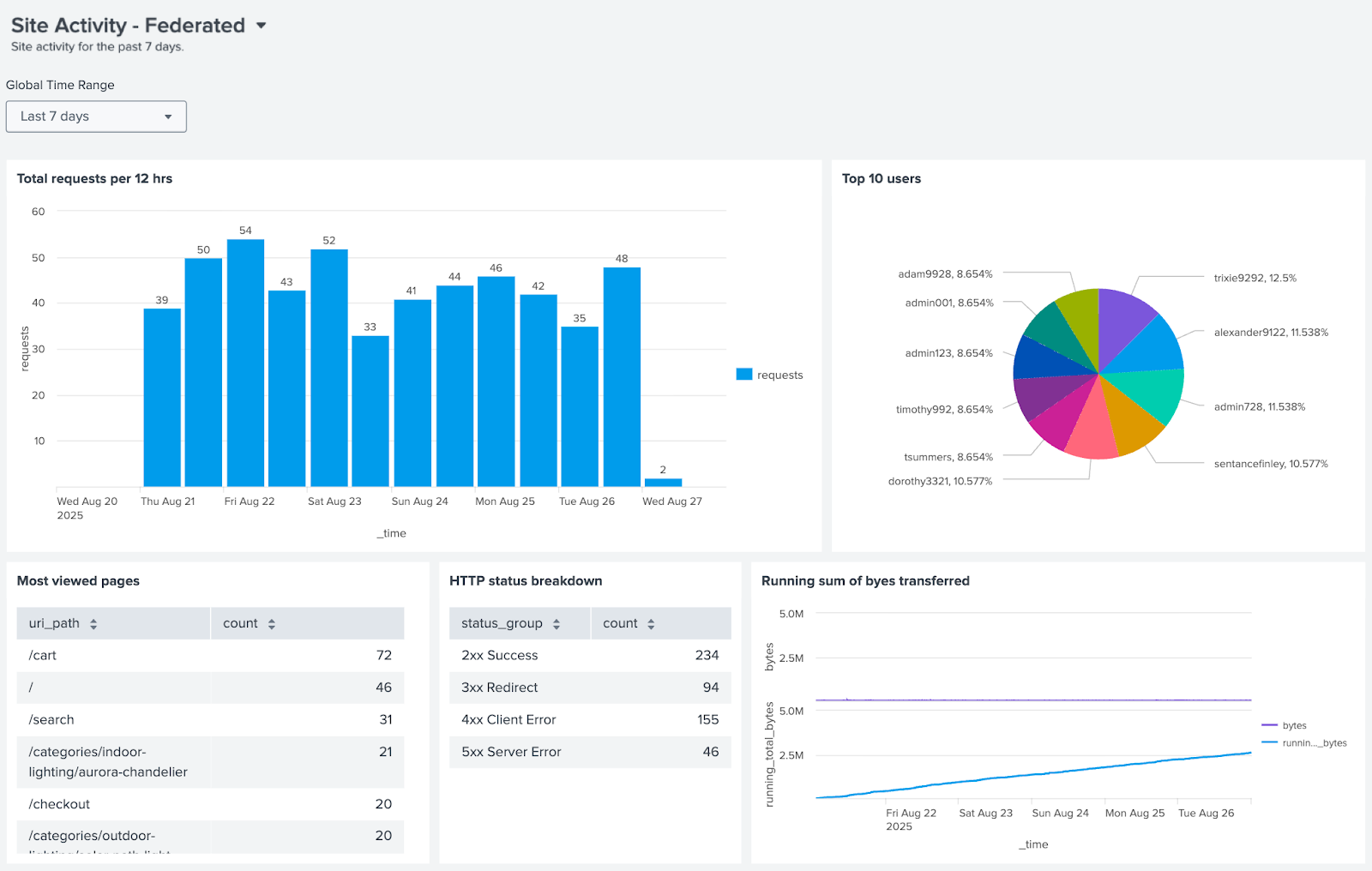
We’ve been hard at work expanding our support for Splunk Knowledge Objects. Data models are now supported, allowing you to create a unified view of your data across both Lumi and Splunk. Configure the data model integration in Lumi to seamlessly analyze Lumi events alongside your Splunk data without changing your existing queries or workflows. For example, use the Web data model to analyze Lumi web server logs alongside your Splunk security events.
Lumi in your own cloud environment
Lumi Enterprise is now available.
With Lumi Enterprise, you can deploy Lumi in your own AWS environment while retaining the benefits of the managed SaaS experience.
This deployment option enables:
- Greater control over data residency and compliance
- Deployment in regulated or restricted environments
- Seamless alignment with existing cloud infrastructure
What’s next
We’re excited to continue to expand Imply Lumi’s performance, manageability, and ecosystem integrations as we build on its decoupled foundation for observability and security.
Check out the product preview blog and keep an eye on- the docs for the latest updates as new capabilities and integrations become available.
Related articles
More from Imply on the same topic.

Search your Splunk DDSS archive without restoring it
Security teams often keep logs long after they have aged out of their SIEM platform’s searchable window. The data is there for investigations or audits, but accessing the data for insights can be complicated.

Claude makes dashboards now, Lumi is ready for them
This week Anthropic launched Claude Dashboards in beta. You connect a data source, ask a question in plain language, and Claude writes the queries and builds the dashboard.

Lumi Lounge Recap: 3 Takeaways from Splunk .conf26
The Imply Lumi Lounge sat directly across the street from Splunk .conf26 and reached venue capacity on both days. Digital signs around the Colorado Convention Center pointed attendees our way with a simple message: “Federated search, done right. Full SPL. Less spend.”


Agents don’t query like your detections do
A security team of four has run a major SIEM since February. Nobody on the team writes SPL. Nobody opens the console or looks at the dashboards. Every question goes through an AI agent, which writes the query, runs it, reads the result, and answers in plain language.

Why You Shouldn’t Have to Delete Your VPC Flow Logs
When a security incident happens, investigators almost always start with the same questions: Which systems communicated? Where did the traffic originate? What changed before the incident? Was data exfiltrated? AWS VPC Flow Logs are often the fastest way to answer those questions.

Splunk Smartstore vs Lumi Loglake: Two Very Different Ways to Search Logs in Object Storage
One copies data back before it can be searched. The other queries it where it lives. Lumi Loglake lets Splunk teams query logs directly in object storage, including AWS S3, Delta Lake, Apache Iceberg, using standard SPL.
Supercharging Schema-On-Read: Logs in Object Storage Don’t Need a Data Catalog
Machine data architectures are rapidly changing. As telemetry volumes continue to grow and as costs rise, organizations are increasingly moving logs and other machine data into object stores such as AWS S3.

Imply Lumi Loglake vs Splunk Federated Search for S3
Teams are increasingly moving log data into AWS S3 to reduce costs and extend retention. Both Lumi Loglake and Splunk Federated Search to S3 help you query data in AWS S3 to lower costs, however the two technologies have several notable differences.

A First Look at Lumi Loglake: Query Logs Where They Live
TL;DR: Imply Lumi Loglake is a lakehouse (separated compute/storage) architecture for unstructured logs that reduces costs from 40% up to orders of magnitude on your hardware/AWS/Azure bill used to run your SIEM/observability products.

Imply Lumi Major Release Preview: Continuing the Journey Towards Decoupled Observability/SIEM
We are getting ready to introduce the next major expansion of Imply Lumi and the observability warehouse. When we introduced the industry’s first observability warehouse, the goal was clear: decouple the observability stack by separating storage, compute, and access.

Query Lumi from Grafana: Now in Private Preview
Observability has a silo problem. Today, we’re removing another one. Imply Lumi’s Grafana Loki integration is now in Private Preview.
