
Introducing Imply Lumi: The Industry’s First Observability Warehouse


Every organization I talk to wants the same three things: keep more data, search it faster, and spend less doing it. The problem isn’t ambition — it’s architecture.
Today’s observability platforms weren’t built for the data realities we face now — or for the AI/ML workloads that are quickly becoming table stakes. As data grows, costs rise, performance lags, and teams are forced into painful trade-offs: shorter retention, reduced fidelity, and slower insights.
That’s why we built Imply Lumi — the industry’s first Observability Warehouse. Imply Lumi is a high-performance, drop-in data layer that works with your existing tools. Instead of every solution owning its own expensive storage and indexing layer, Imply Lumi provides a shared foundation that can power them all.
The State of Observability: A Breaking Point
Our recent survey of 132 observability and platform admin professionals paints a clear picture:

The bottom line: teams are being asked to do more with data while the architecture underneath them is holding them back.
What Business Intelligence (BI) Can Teach Us
This isn’t the first time enterprise data has hit a wall. Business Intelligence faced the same challenges decades ago — and solved them on its path to become a $100B+ market.
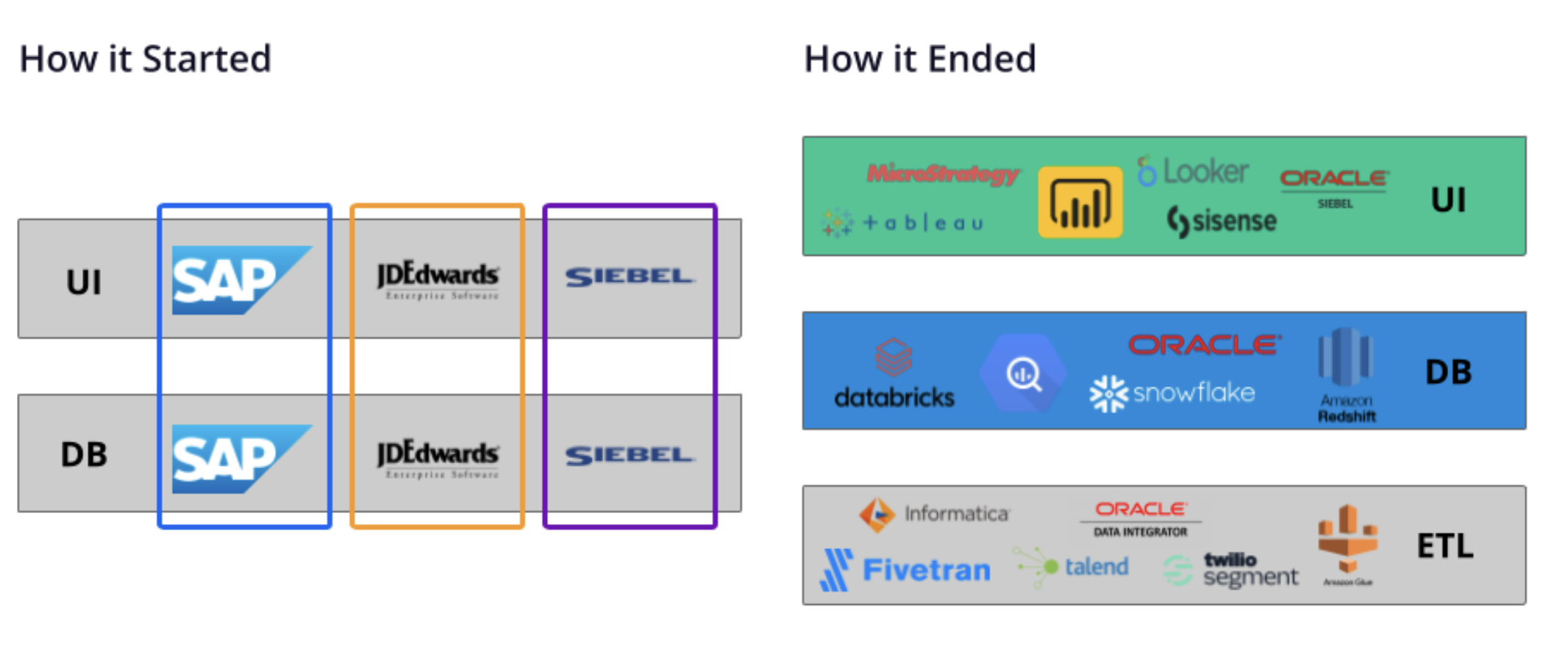
How it started
BI began as tightly coupled stacks where the database and the user interface (UI) were fused together. Every application was its own silo, with no flexibility to change layers or share data across tools.
How it evolved
As BI evolved, decoupling became the key enabler of scale. A three-layer architecture emerged:
- Visualization — dashboards and analysis tools (e.g., Tableau, Looker, Power BI)
- Database / Compute — centralized engines for query and storage
- ETL — pipelines for data acquisition and transformation
This decoupling created flexibility and efficiency. Teams could swap visualization tools without moving the data, or change the engine under the hood without retraining users. That flexibility is what allowed BI to mature into today’s $100B+ market.
Observability is now at the same inflection point. The first signs of decoupling are already here with OpenTelemetry, the emerging open standard for data collection, and Grafana, which is widely used as a visualization layer. But collection and visualization alone isn’t enough. Like BI before it, the way forward is a high-performance warehouse: a shared, high-efficiency foundation that breaks down silos, reduces duplication, and powers many tools at once.
Meet Imply Lumi: The Observability Warehouse
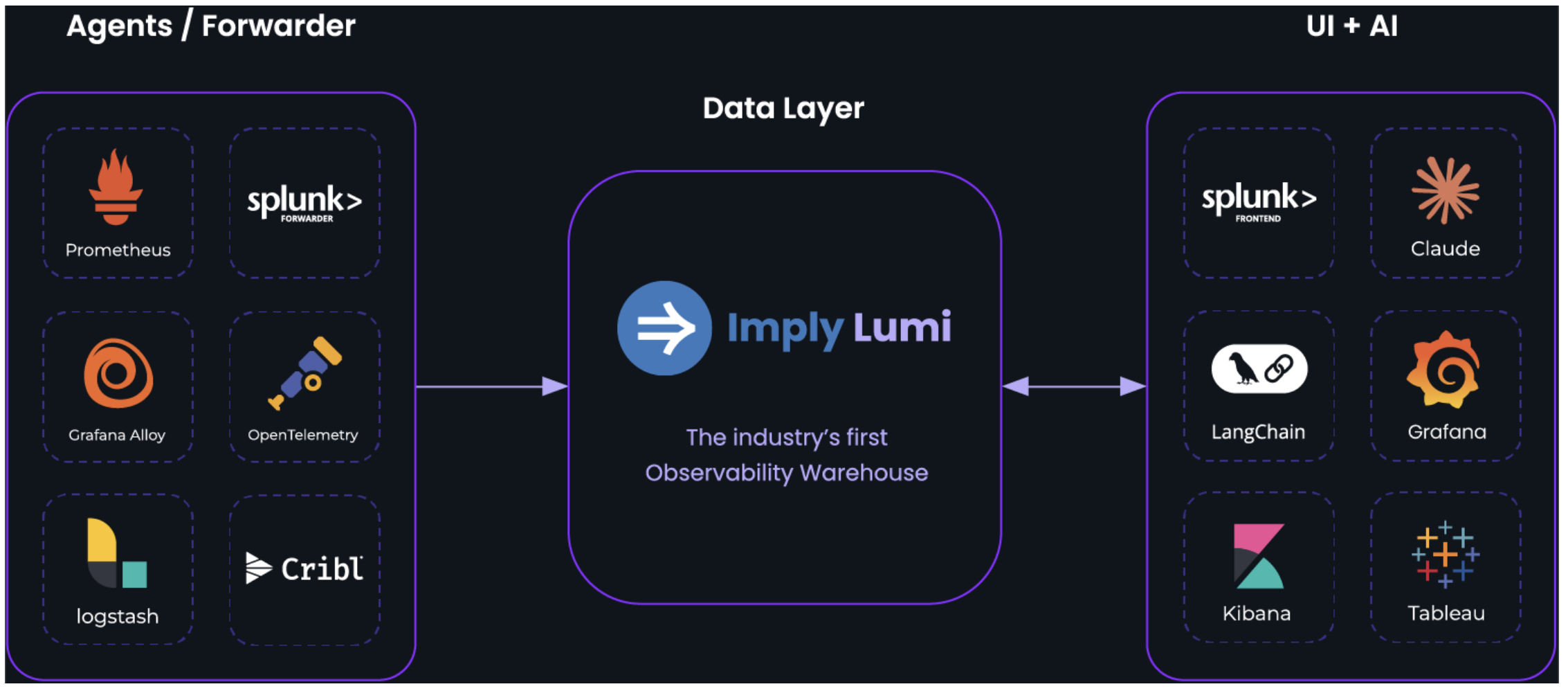
Imply Lumi is a high-performance data warehouse for observability — a drop-in data layer that lets you:
- Store more for less → Keep data at your desired fidelity for a fraction of today’s cost
- Search without limits → Run queries of any complexity or duration at the best price–performance
- Keep your workflows → Continue using your existing observability tools and AI copilots — with zero disruption.
At launch, Imply Lumi includes native integrations with Splunk, Grafana, Tableau, and MCP (for AI tools such as ChatGPT and Claude). It runs right alongside your current systems for an easy, low-risk start. And this is only the beginning — additional integrations, including Kibana, are already in progress.
Imply Lumi works with Splunk Universal and Heavy Forwarders, OpenTelemetry, Cribl, and S3 ingestion — preserving sourcetypes, metadata, and field structures so nothing is lost. From day one, it appears as a Splunk-compatible data source for federated search. Your dashboards, alerts, and saved searches keep working exactly as they do now — just faster, with longer retention, and at a fraction of the cost.
See it in action:
Watch how Imply Lumi extends Splunk — more data, faster queries, and lower cost without changing workflows.
Think of it as a sidecar for your observability stack: forward a copy of your data to Imply Lumi for side-by-side comparison, keep your current indexers in place, and flip the switch to make Imply Lumi your primary source when you’re ready.
This makes adoption painless — no need to rip and replace your current platform, retrain your teams, or rewrite pipelines. You can start small, prove the value, and scale confidently.
What You Can Do with Imply Lumi
With Imply Lumi, Splunk remains your home base — but now you can do much more:
- Cloud Data
Use Splunk for cloud-native datasets that were previously too expensive to ingest. Bring in high-volume logs like CloudWatch, CloudTrail, and VPC Flow without filtering or budget blowups. Simply connect Lumi to the S3 bucket that has these logs and then start querying them from Splunk. - AI/ML
Query observability data through natural language or build or your AI agents with tools such as Langchain, Claude, ChatGPT. Keep long-term datasets hot to power model training, anomaly detection, and future AI workloads. Or simply enable anyone in the organization to use natural language to search logs.
- Broad Ecosystem
Serve the same dataset to multiple tools — Splunk, Grafana, Tableau, and more — without duplicating ingestion. Thinking of migrating to a new tool? Imply Lumi reduces risk by allowing you to keep your data in one place while switching to the new tool
Imagine keeping a full year of data hot and searchable without having to justify it to finance — or running a cross-system search that ties together security, infrastructure, and application events in seconds instead of hours. These aren’t “someday” capabilities. With Imply Lumi, they’re available on day one.
Final Thoughts
Imply Lumi is more than an optimization layer — it’s the foundation of a new architecture for observability. By introducing a shared warehouse for event data, Imply Lumi lets you retain more, search faster, and spend less, all while keeping your existing workflows intact.
This shift creates a central data layer that can power every part of your observability ecosystem — from Splunk to Grafana to AI copilots — without silos or trade-offs.
Contact us to see Imply Lumi in action — and discover how much more your observability stack can do when it’s built on a warehouse, not a bottleneck.
–> Read about our recent updates to Imply Lumi:
A First Look at Lumi Loglake: Query Logs Where They Live
Imply Lumi Loglake vs Splunk Federated Search for S3
Related articles
More from Imply on the same topic.

Search your Splunk DDSS archive without restoring it
Security teams often keep logs long after they have aged out of their SIEM platform’s searchable window. The data is there for investigations or audits, but accessing the data for insights can be complicated.

Claude makes dashboards now, Lumi is ready for them
This week Anthropic launched Claude Dashboards in beta. You connect a data source, ask a question in plain language, and Claude writes the queries and builds the dashboard.

Lumi Lounge Recap: 3 Takeaways from Splunk .conf26
The Imply Lumi Lounge sat directly across the street from Splunk .conf26 and reached venue capacity on both days. Digital signs around the Colorado Convention Center pointed attendees our way with a simple message: “Federated search, done right. Full SPL. Less spend.”

Agents don’t query like your detections do
A security team of four has run a major SIEM since February. Nobody on the team writes SPL. Nobody opens the console or looks at the dashboards. Every question goes through an AI agent, which writes the query, runs it, reads the result, and answers in plain language.

Why You Shouldn’t Have to Delete Your VPC Flow Logs
When a security incident happens, investigators almost always start with the same questions: Which systems communicated? Where did the traffic originate? What changed before the incident? Was data exfiltrated? AWS VPC Flow Logs are often the fastest way to answer those questions.

Splunk Smartstore vs Lumi Loglake: Two Very Different Ways to Search Logs in Object Storage
One copies data back before it can be searched. The other queries it where it lives. Lumi Loglake lets Splunk teams query logs directly in object storage, including AWS S3, Delta Lake, Apache Iceberg, using standard SPL.
Supercharging Schema-On-Read: Logs in Object Storage Don’t Need a Data Catalog
Machine data architectures are rapidly changing. As telemetry volumes continue to grow and as costs rise, organizations are increasingly moving logs and other machine data into object stores such as AWS S3.

Imply Lumi Loglake vs Splunk Federated Search for S3
Teams are increasingly moving log data into AWS S3 to reduce costs and extend retention. Both Lumi Loglake and Splunk Federated Search to S3 help you query data in AWS S3 to lower costs, however the two technologies have several notable differences.

A First Look at Lumi Loglake: Query Logs Where They Live
TL;DR: Imply Lumi Loglake is a lakehouse (separated compute/storage) architecture for unstructured logs that reduces costs from 40% up to orders of magnitude on your hardware/AWS/Azure bill used to run your SIEM/observability products.

Imply Lumi Major Release Preview: Continuing the Journey Towards Decoupled Observability/SIEM
We are getting ready to introduce the next major expansion of Imply Lumi and the observability warehouse. When we introduced the industry’s first observability warehouse, the goal was clear: decouple the observability stack by separating storage, compute, and access.

Query Lumi from Grafana: Now in Private Preview
Observability has a silo problem. Today, we’re removing another one. Imply Lumi’s Grafana Loki integration is now in Private Preview.
